
Can insects kill a tree? A few words about tree pests
Working with my patients every day (yes, I call the trees I meet on the job "patients" - a habit I picked up from my mentor Marek Kubacki, who I'd like to say hello to here), I regularly hear: "The bark beetles ate my tree!" Usually, that's not quite true.
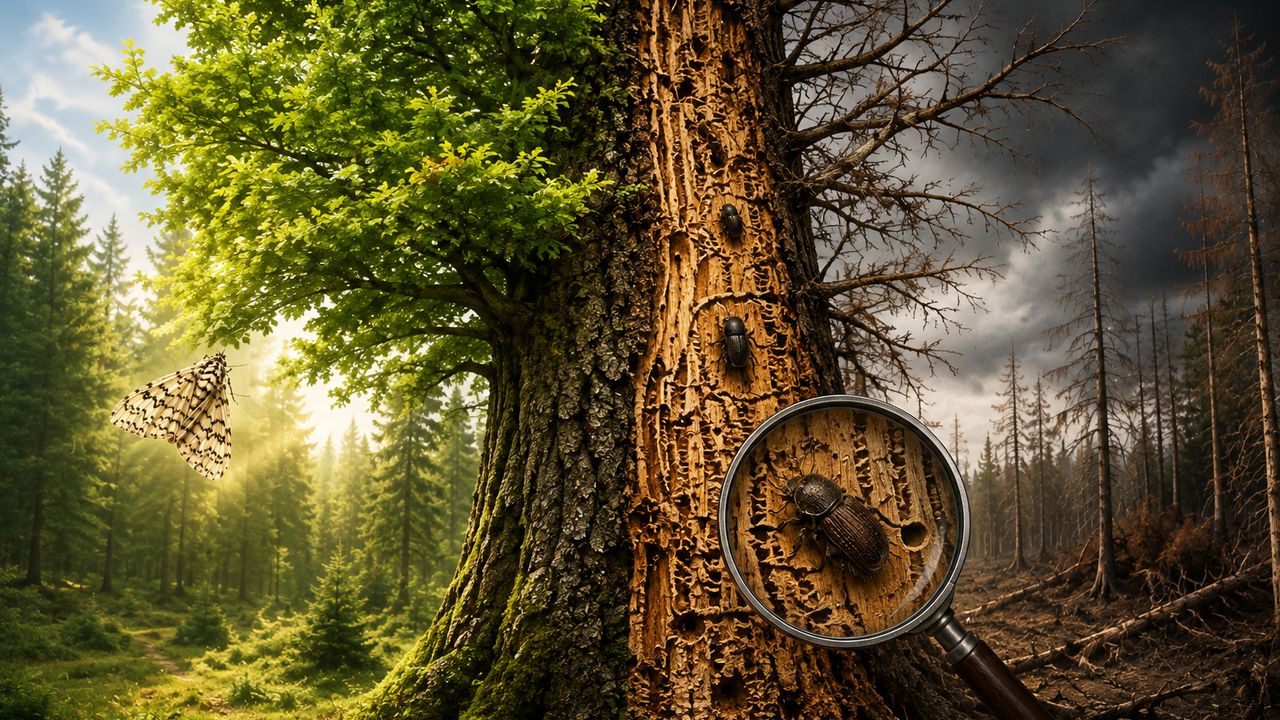
Working with my patients every day (yes, I call the trees I meet on the job “patients” - a habit I picked up from my mentor Marek Kubacki, who I’d like to say hello to here), I regularly hear: “The bark beetles ate my tree!” Usually, that’s not quite true. I’ll get to when bark beetles actually are responsible - and when they’re not - in a moment.
In the industry, we broadly distinguish two types of pests:
- primary pests (folivores), which, during mass outbreaks, can kill not just a single tree but entire stretches of forest;
- secondary pests (mainly bark and wood borers), which usually attack trees that are already weakened, and often finish the job.
Primary pests: not where you’d expect
Here’s the first surprise: it’s not bark beetles. The most dangerous primary pests are actually moths - creatures most of us find rather charming. In Poland, the biggest headache for foresters is the nun moth (Lymantria monacha). The outbreaks of this species between 1978 and 1986 went down in history. This seemingly harmless moth attacked over 6 million hectares of forest, with more than 2.5 million hectares affected in a single peak year - an area comparable to two mid-sized U.S. counties combined, or roughly the size of Connecticut and Rhode Island together.
Outbreaks of primary pests tend to recur, which is why foresters continuously monitor their population and growth trends (short-term forecasting), using methods such as:
- pheromone traps, which lure males with a scent that mimics the female pheromone;
- autumn ground surveys, i.e. digging up 1 m² plots across the forest to count pupae and caterpillars that have gone underground for winter;
- spring “mirror” counts - spotting clusters of freshly hatched nun moth larvae. Before climbing into the canopy to feed on needles, they gather tightly on the trunk, where their bodies catch the light against the bark - hence the name “mirrors.” Forecasting outbreaks makes it possible to react faster and prepare control measures in time.
Secondary pests: this is where bark beetles finally show up (though not always)
This is usually where your favorite bark beetles come in - though not always. Unlike primary pests, secondary pests typically attack trees that are already weakened, for reasons such as:
- drought;
- total defoliation caused by primary pests (a tree losing all its needles or leaves in a single season);
- fires;
- natural mechanical damage, like strong winds or heavy, wet snow breaking branches;
- human-caused mechanical damage - careless, oversized cuts made by unqualified “tree climbers” (the kind I like to call “weekend warriors with a chainsaw”);
- environmental pollution;
- fungal diseases, which those same careless cuts often invite, by creating open wounds that serve as infection points.
Sometimes, as with the European spruce bark beetle (Ips typographus) - the most dangerous pest of spruce - even mild weakening is enough to trigger a mass outbreak. Even a slightly weakened tree can’t mount an effective defense: it can’t flood every attacking beetle with resin fast enough. The mechanism is simple: a tree can easily fend off a handful of beetles, but not an entire wave arriving at once. It’s sheer numbers that break through the defense.
The takeaway: prevention
In short: prevention and keeping trees in good condition is what matters most. In this respect, trees are a lot like us - a weakened body gives pathogens and pests an easier opening, and they’re always waiting for exactly that kind of opportunity.